

The lecture provides a systematic overview of the field of empathic computing at the interface of human-computer interaction, extended reality, affective computing, and virtual worlds. The focus is on how interactive systems can be designed to enable people to better understand and empathize with the perspectives, experiences, thought processes, and emotions of others, especially in distributed and immersive collaboration scenarios.
| Type | Lecture |
| Term | SS 2026 |
| Starting | 14.04.2026 at 10:30am |
| Mentor(s) |
Wolfgang Prinz |
| Assistant(s) |
Benedikt Hensen |
| Moodle |
visit |
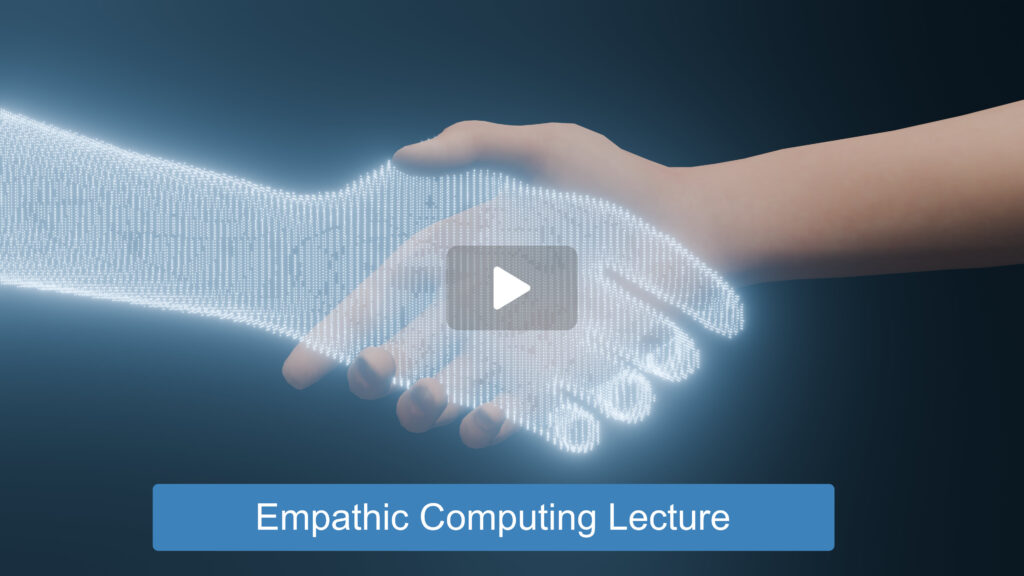
A 2 minute information video about the lecture’s content
Extended reality, consisting of augmented reality and virtual reality, is presented as a central medium for making experiences, situations and cognitive states tangible and for sharing them in a comprehensible way. Covered Topics include among others:
- Fundamentals of empathic interaction: models of social presence and the role of attention in collaborative scenarios
- Extended reality as a medium for shared experiences
- Methods for natural collaboration in XR environments
- Design processes and principles for creating spatial and immersive user interfaces
- Methods for capturing a person’s experiences and situations, e.g., 3D scene capture, volumetric reconstruction and sensor fusion
- Representation methods for communicating transmitted experiences to others, such as Gaussian splatting, avatar representations and data visualizations
- Sensor technology and signal acquisitions for determining behavior patterns in a given context
- Algorithmic methods for understanding and interpreting behavior, emotions, and cognitive states, e.g., by AI-supported classification with large language models
- Methods for evaluating the quality of empathic computing systems
- Consideration of ethical and social frameworks, as well as data privacy
- Areas of application for empathic computing, such as distributed collaboration and training in medicine, mechanical engineering, therapy, culture and art
The presented content provides a clear introduction and overview of the central concepts of empathic computing, as well as the associated technologies, algorithms, methods, and current research questions.